•  

China: Octopus Clings to Phone After Being Caught by Fisher in Fuzhou

In Fuzhou, Fujian, a video captured a man fishing when he unexpectedly caught an octopus with a phone stuck to one of its tentacles on September 28. The octopus refused to let go, wrapping its arms tightly around the device as if claiming it as its own.

  •  
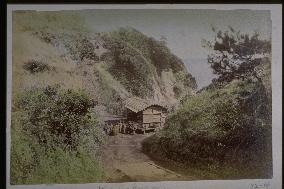
A mountain path and a teahouse

A mountain path and a teahouse

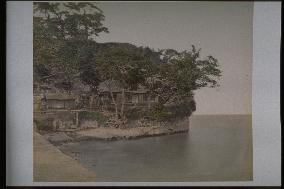
Photographer unknown. Entitled Kamakura. A shack that could be a teahouse is visible between two hills. According to the lithographic map The Illustrated Map of Enoshima, Kugenuma, Zushi, and Kanazawa of 1896, this is probably one of the scenic points around Yamafutatsu (literally Two Mountains ) located between Nakatsumiya and Okitsumiya of Enoshima Shinto Shrine.==Date:unknown, Place:Enoshima, Photo:unknown, (Credit:Nagasaki University Library/Kyodo News Images) [Cabinet Number92‐14‐0]

  •  
Kanazawa Hakkei

Kanazawa Hakkei

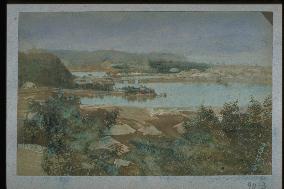
Hiragata Bay as seen from Kyurantei. Biwajima Benten is visible in the centre, with Seto Shinto Shrine at the tip of the peninsula. The teahouses on the right of the shrine are (from the left) Chiyomoto-ro and Ogiya, and Azumaya is in the rear. Suzaki Village is on the other side of Seto Bridge from Ogiya.==Date:unknown, Place:Yokohama, Photo:unknown, (Credit:Nagasaki University Library/Kyodo News Images) [Cabinet Number90‐3‐0]

  •  
Kanazawa Hakkei

Kanazawa Hakkei

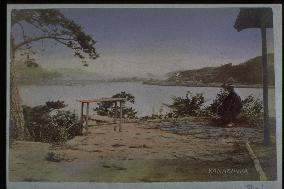
Taken at Kyurantei in the Kinryuin Temple grounds, this same photograph was published in the March 16, 1872 issue of The Far East. To the right of Hiragata Bay is Muronoki, to the left is part of Nojima, and further back lies Natsushima Island. Kyurantei was famous as a spot to enjoy all of the Kanazawa Hakkei ( Eight Scenic Places of Kanazawa ).==Date:unknown, Place:Yokohama, Photo:unknown, (Credit:Nagasaki University Library/Kyodo News Images) [Cabinet Number90‐1‐0]

  •  
A teahouse at Honmoku Juniten

A teahouse at Honmoku Juniten

A road to Honmoku and Negishi was built for foreigners in 1864. Horse carriages were able to pass the following year, and many visitors came along the foot of the hill to enjoy the scenic beauty of Honmoku Juniten Shinto Shrine. Teahouses were built along the road, and people enjoyed bathing and gathering shellfish.==Date:unknown, Place:Yokohama, Photo:Tamamura Kozaburo, (Credit:Nagasaki University Library/Kyodo News Images) [Cabinet Number68‐3‐2]

  •  
The people of a teahouse

The people of a teahouse

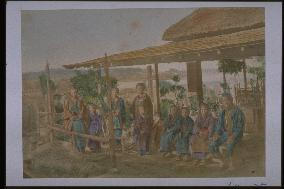
Many adults and children are resting at a tea house with a thatched roof. The poles in the front suggest that this is a rest spot near a river or the sea.==Date:unknown, Place:unknown, Photo:unknown, (Credit:Nagasaki University Library/Kyodo News Images) [Cabinet Number64‐35‐0]

  •  
A teahouse at Honmoku Juniten

A teahouse at Honmoku Juniten

A road to Honmoku and Negishi was built for foreigners in 1864. Horse carriages were able to pass the following year, and many visitors came along the foot of the hill to enjoy the scenic beauty of Honmoku Juniten Shinto Shrine. Teahouses were built along the road, and people enjoyed bathing and gathering shellfish.==Date:unknown, Place:Yokohama, Photo:unknown, (Credit:Nagasaki University Library/Kyodo News Images) [Cabinet Number64‐28‐0]

  •  
A teahouse at Honmoku Juniten

A teahouse at Honmoku Juniten

A road to Honmoku and Negishi was built for foreigners in 1864. Horse carriages were able to pass the following year, and many visitors came along the foot of the hill to enjoy the scenic beauty of Honmoku Juniten Shinto Shrine. Teahouses were built along the road, and people enjoyed bathing and gathering shellfish.==Date:unknown, Place:Yokohama, Photo:unknown, (Credit:Nagasaki University Library/Kyodo News Images) [Cabinet Number55‐34‐0]

  •  
A teahouse at Honmoku Juniten

A teahouse at Honmoku Juniten

A road to Honmoku and Negishi was built for foreigners in 1864. Horse carriages were able to pass the following year, and many visitors came along the foot of the hill to enjoy the scenic beauty of Honmoku Juniten Shinto Shrine. Teahouses were built along the road, and people enjoyed bathing and gathering shellfish.==Date:unknown, Place:Yokohama, Photo:unknown, (Credit:Nagasaki University Library/Kyodo News Images) [Cabinet Number55‐5‐0]

  •  
A woman smoking at a teahouse

A woman smoking at a teahouse

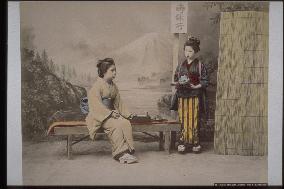
The woman on the bench has her hair arranged in marumage style. She is wearing a lined kimono with a taiko (drum sash. The woman working in the tea house wears an apron and has her kimono sleeves tied up. A tobacco tray is placed on the bench, and a reed screen is leaning against the shop for shade. Mt. Fuji is visible across the sea.==Date:unknown, Place:unknown, Photo:unknown, (Credit:Nagasaki University Library/Kyodo News Images) [Cabinet Number51‐167‐0]

  •  
A teahouse at Honmoku Juniten

A teahouse at Honmoku Juniten

A road to Honmoku and Negishi was built for foreigners in 1864. Horse carriages were able to pass the following year, and many visitors came along the foot of the hill to enjoy the scenic beauty of Honmoku Juniten Shinto Shrine. Teahouses were built along the road, and people enjoyed bathing and gathering shellfish.==Date:unknown, Place:Yokohama, Photo:Tamamura Kozaburo, (Credit:Nagasaki University Library/Kyodo News Images) [Cabinet Number48‐88‐0]

  •  
A teahouse at Honmoku Juniten

A teahouse at Honmoku Juniten

A promenade for foreigners was made around the Bluff, Honmoku and Negishi in 1864. Juniten shrine is the guardian of Hongo village in Honmoku. The scenic Honmoku Juniten has a side road, and there were tea houses along the way.==Date:unknown, Place:Yokohama, Photo:Suzuki Shin-ichi, (Credit:Nagasaki University Library/Kyodo News Images) [Cabinet Number41‐16‐0]

  •  
Usui Pass from Nakasendo Sakamoto Inns

Usui Pass from Nakasendo Sakamoto Inns

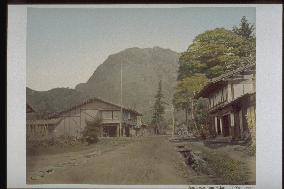
Sakamoto juku is located at the eastern foot of the range, and the 600 meters distance from here (500 meters above sea level) to the range is a climb of 450 meters. Hotels line along the road with a width of 15 meters. The mountain that looks like a pile of rocks is the Funzan. This path leads to Usui Range.==Date:unknown, Place:Gunma, Photo:Kusakabe Kinbei, (Credit:Nagasaki University Library/Kyodo News Images) [Cabinet Number38‐54‐0]

  •  
A teahouse at Honmoku Juniten

A teahouse at Honmoku Juniten

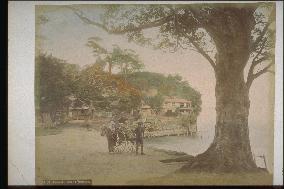
In the last days of the Tokugawa period, a promenade for foreigners was opened between Honmoku and Negishi in the south part of the Bluff. Honmoku Juniten was famous for its scencery and had branch roads. The Junitensha is the guardian of Honmoku Hongo village. The photo shows the tea shop protruding to the beach, which was also a bathing spot.==Date:unknown, Place:Yokohama, Photo:Ogawa Kazumasa, (Credit:Nagasaki University Library/Kyodo News Images) [Cabinet Number10‐8‐0]

  •  
A teahouse at Nogeyama Park

A teahouse at Nogeyama Park

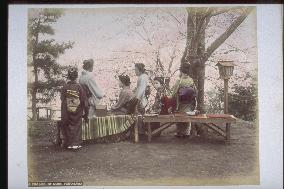
The caption reads Hill of Noge, Yokohama in English. Nogeyama was a residential district for Yokohama merchants. After the Great Kanto Earthquake, this area became Nogeyama Park. Six young women sit to the side of the guardman's street enjoying the view of cherry blossoms in full bloom.==Date:unknown, Place:Yokohama, Photo:Ogawa Kazumasa, (Credit:Nagasaki University Library/Kyodo News Images) [Cabinet Number6‐45‐0]

  •  
A teahouse at Honmoku Juniten

A teahouse at Honmoku Juniten

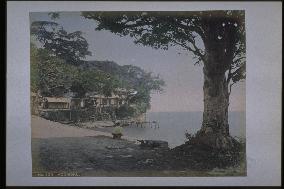
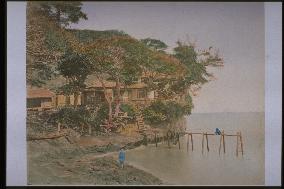
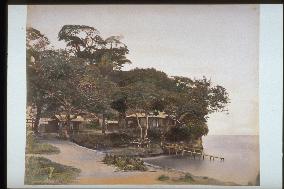
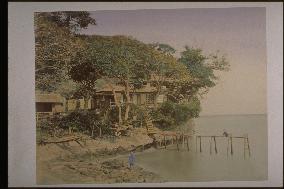
The caption reads View of Honmoku Bathing Place near Yokohama in English. This is the tea house at Juniten near Honmoku beach, which was a resort and a beach for bathing. The wooden bridge protruding toward the sea may be a pier for boats or for swimming.==Date:unknown, Place:Yokohama, Photo:Kusakabe Kinbei, (Credit:Nagasaki University Library/Kyodo News Images) [Cabinet Number3‐13‐0]

  •  
A teahouse at Honmoku Juniten

A teahouse at Honmoku Juniten

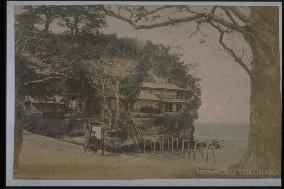
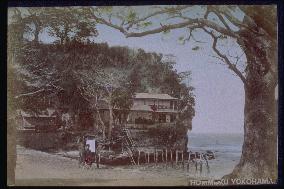
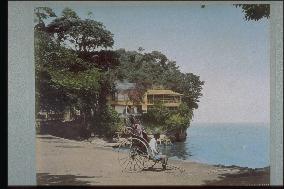
Caption reads The garden and tea house of a residence near Yokohama in German. The photo shows a tea house located in Juniten at the seaside in the suburbs of Yokohama. The rickshaw carries children, and a woman walks along with it on the seaside path wearing an okosozukin (a combination of hood and veil).==Date:unknown, Place:Yokohama, Photo:Kusakabe Kinbei, (Credit:Nagasaki University Library/Kyodo News Images) [Cabinet Number1‐46‐0]

  • Main
  • Top
  • Editorial
  • Creative
  • About Us
  • About ILG
  • Terms of use
  • Company
  • BEHIND
  • Price List
  • Single Plan
  • Monthly Plan
  • Services
  • Shooting
  • Rights Clearance
  • Support
  • FAQ
  • How To Buy
  • Contact Us
  • Become a Partner

© KYODO NEWS IMAGES INC

All Rights Reserved.

  • Editorial
  • Olympics
  • News
  • Sports
  • Japan
  • Tech
  • Royal
  • Disaster
  • NorthKorea
  • Old Japan
  • SNS
  • Creative
  • Food
  • Japan
  • Landscape
  • Animal
  • Popular
  • #Ukraine
  • #Russia
  • #coronavirus
  • #N. Korea
  • #Thailand
  • #China
  • #Ukraine
  • #Russia
  • #coronavirus
  • #N. Korea
  • #Thailand
  • #China
  • Food
  • Japan
  • Landscape
  • Animal
  • Olympics
  • News
  • Sports
  • Japan
  • Tech
  • Royal
  • Disaster
  • NorthKorea
  • Old Japan
  • SNS